
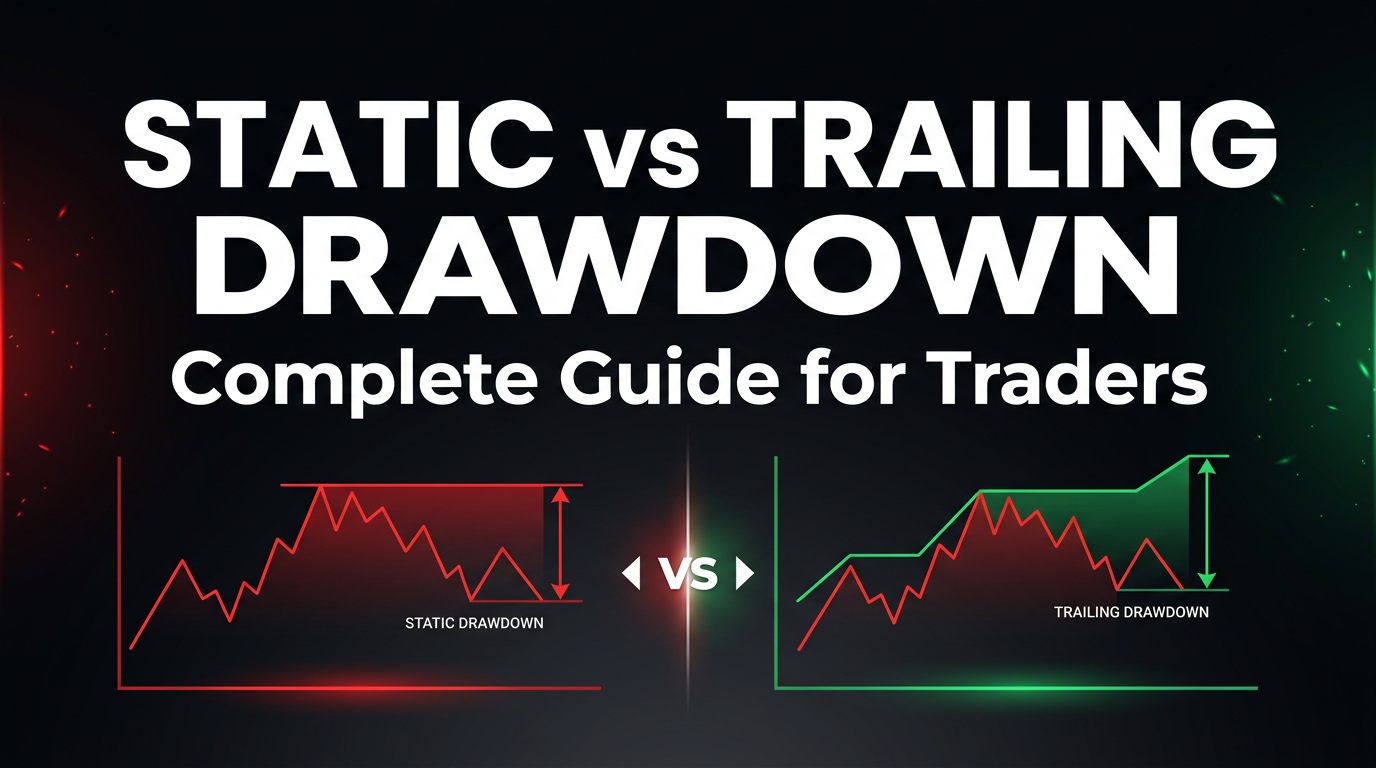
What is drawdown in prop trading?
Drawdown is the maximum allowed decline in your trading account before the firm terminates it. Three types exist: static (measured from starting balance), trailing (follows your equity high), and end-of-day (only checks balance at market close). Static drawdown is the most trader-friendly.
Static vs Trailing Drawdown – Complete Guide
Understanding drawdown rules is arguably the most important aspect of trading with a prop firm. The difference between static and trailing drawdown can mean the difference between keeping your funded account and losing it. This complete guide explains both types in detail, shows real-world examples, and helps you choose firms with drawdown rules that match your trading style.

What Is Drawdown in Prop Trading?
Drawdown represents the maximum amount your account can decline from a reference point before the firm closes your account. It's the firm's primary risk management tool, ensuring that traders don't lose too much of the firm's capital. Every prop firm has drawdown rules, but how they calculate drawdown varies significantly.
Static Drawdown Explained
Static drawdown (also called fixed or absolute drawdown) is measured from your starting balance and never changes. If you have a $100,000 account with a 10% static drawdown, your account will be closed if your balance drops below $90,000 at any point — regardless of how much profit you've made previously.
Static Drawdown Example
Starting balance: $100,000. Maximum drawdown: 10% ($10,000). Your account termination level is fixed at $90,000.
Day 1: You make $5,000. Balance: $105,000. Termination level: still $90,000. Day 2: You lose $3,000. Balance: $102,000. Termination level: still $90,000. Day 3: You lose $8,000. Balance: $94,000. Termination level: still $90,000. You're still safe because $94,000 > $90,000.
With static drawdown, your cushion actually grows as you make profits. In this example, you had $15,000 of room at peak ($105,000 - $90,000) even though the original drawdown was only $10,000.
Trailing Drawdown Explained
Trailing drawdown (also called relative drawdown) moves upward with your highest achieved equity or balance. The maximum loss limit trails your peak, meaning your cushion never increases beyond the initial drawdown amount — and it can shrink as your account grows.
Trailing Drawdown Example
Starting balance: $100,000. Maximum drawdown: 10% ($10,000). Initial termination level: $90,000.
Day 1: You make $5,000. Balance: $105,000. New termination level: $95,000 ($105,000 - $10,000). Day 2: You lose $3,000. Balance: $102,000. Termination level: still $95,000 (trails from the peak). Day 3: You lose $8,000. Balance: $94,000. Termination level: $95,000. Account terminated!
Notice the difference: with the same trading results, you survived with static drawdown but were terminated with trailing drawdown. This is why the distinction is so critical.
Balance-Based vs Equity-Based Trailing
There's an important sub-distinction within trailing drawdown. Balance-based trailing only moves up when you close a profitable trade (realized profits). Equity-based trailing moves up in real-time with your floating/unrealized profits.
Equity-based trailing is far more restrictive. If you have an open trade with $5,000 in unrealized profit, your trailing drawdown limit has already moved up by $5,000 — even though you haven't locked in those profits yet. If the trade reverses, you're now much closer to termination.
Daily Drawdown vs Overall Drawdown
Most firms have both a daily drawdown limit and an overall (maximum) drawdown limit. Daily drawdown resets each day and limits how much you can lose in a single trading day (typically 4-5%). Overall drawdown is the total maximum loss allowed (typically 8-12%).
Understanding whether each drawdown type is static or trailing is essential. Some firms use static overall drawdown but trailing daily drawdown, or vice versa. Always clarify both.
Which Is Better for Traders?
Static drawdown is almost universally preferred by traders for several reasons. It provides a clear, fixed safety net. Profits genuinely increase your cushion. You can take calculated risks knowing your exact termination level. There's no penalty for being profitable.
Trailing drawdown creates a paradox: the more profitable you are, the more you can lose but the same absolute amount puts you at risk. It effectively limits your maximum loss to the initial drawdown amount, regardless of how much you've earned.
Strategies for Managing Trailing Drawdown
If you must trade with trailing drawdown, withdraw profits as frequently as possible to reset your effective cushion. Take partial profits on winning trades rather than letting them run. Reduce position sizes after profitable periods. Never leave large unrealized profits on equity-based trailing accounts.
Firms with Static Drawdown
FTMO, Funded Next, MyFundedFX, and several other top firms use static drawdown for their standard challenge accounts. Check our comparison tables for drawdown type details on every firm.
Frequently Asked Questions
Can trailing drawdown lock in profits?
Some firms have a "trailing until initial balance" model where the drawdown trails up to your starting balance and then becomes static. This is a middle ground that many traders find acceptable.
Which drawdown type is more common?
Static drawdown has become more common as firms compete for traders. Trailing drawdown was more prevalent in earlier prop firm models but is increasingly seen as less trader-friendly.
Does drawdown type affect my trading strategy?
Significantly. With trailing drawdown, you need to be more conservative with profit targets and more aggressive about taking profits. With static drawdown, you have more freedom to let winners run.
What's worse: tight static or loose trailing drawdown?
Generally, a moderate static drawdown (8-10%) is preferable to a generous trailing drawdown (12-15%) because static provides predictability and rewards profitability.
Compare Drawdown Rules Instantly
Use our prop firm comparison tool to filter firms by drawdown type and find the best match for your risk management style.
💰 Use Code MINDED to get up to 50% discount
50% OFF first 2 accounts • 40% OFF next 5 accounts
🔥 Funded Squad — 50% OFF Instant Discount
Use code MINDED for 50% instant discount — biggest savings anywhere!
Save up to 50% OFF — no other influencer offers this deal.
💰 The 5%ers — Use Code MINDED for Exclusive Discount
Use code MINDED for an exclusive discount on The 5%ers. Start your funded trading journey today!
🏆 Not Sure? Compare Prop Firms Before You Buy
Use our free Smart Compare tool to find the best firm — with real trust scores and verified reviews.
Drawdown Rules: What Every Trader Must Know
- Static drawdown: your floor stays fixed at starting balance minus the drawdown %
- Trailing drawdown: your floor moves up as your equity reaches new highs
- EOD drawdown: only evaluates your balance at end of each trading day
- Most firms use 5-10% daily and 8-12% maximum drawdown limits
- Trailing drawdown is the hardest to manage — profits can raise your floor
- Always check drawdown type on MindedTrader before purchasing a challenge
Drawdown Type Comparison
| Feature | Static | Trailing | EOD |
|---|---|---|---|
| Difficulty | Easiest | Hardest | Moderate |
| Floor Movement | Never moves up | Follows equity high | Resets daily |
| Best For | All traders | Experienced only | Day traders |
| Intraday Dips | Count against you | Count against you | Don't count |
| Recommendation | ⭐ Preferred | ⚠️ Caution | ✅ Good option |
📊 Compare prop firms side-by-side with trust scores
Frequently Asked Questions
📚 From Our Guide
How Prop Trading Firms Work — Complete Beginner's Guide
Prop firms provide traders with funded accounts to trade financial markets. You pay a challenge fee, prove your skills, and earn profit splits of 70-90%.
Prop Firm vs. Broker Account — Which Is Right for You?
With a prop firm you trade the firm's capital with no PDT restrictions. With a broker you use your own money but keep 100% of profits.
Best Trading Strategies for Prop Firm Challenges in 2026
Consistent, low-risk strategies outperform aggressive approaches. Focus on 1-2% daily targets with strict risk management.
Prop Firm Payout Speeds Compared — Fastest Payouts in 2026
Top firms process payouts in 24-48 hours. Some take 7-14 days. Our rankings factor payout speed into trust scores.